

Module 6 — Knowledge and Thinking Tools · Lesson 6.3
Writing Your Workspace Charter
Know-how, Vision, Negation — and the ledger that shows whether the Negation is doing anything
What you'll learn
- Write a Know-how, Vision and Negation that are specific enough to act on
- Explain exactly what enforcement does and does not cover
- Read the refusal ledger and interpret hits, overrides and top-cited lines
- Diagnose a charter that refuses nothing and one that gets overridden constantly
Almost everything in Kavanah is a tool you point at your work. The charter is the exception: it is the one piece of writing that changes what the product will do. Writing it well is the highest-leverage half hour available in the application, and writing it badly is the reason some workspaces find the agent obstructive and others find it aligned.
The three axes
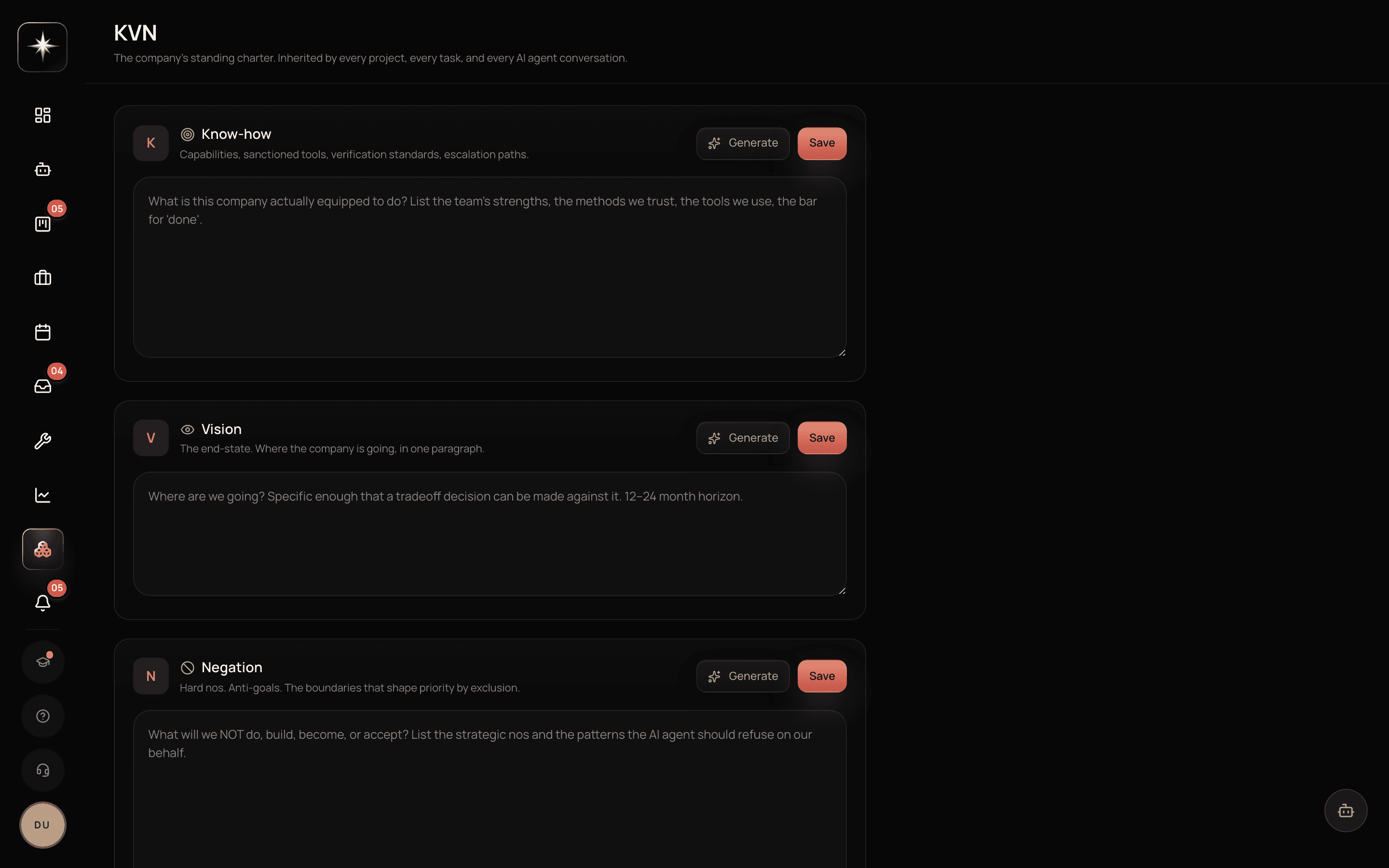
Open KVN under the Workspace group. Admins can edit; everyone else sees it read-only. Each axis saves separately.
Know-how is capacity: what this workspace can actually do. Not aspiration — the skills, the systems, the constraints. It is what stops the agent proposing work you have no way of executing.
Vision is the end-state you are pursuing. Concrete enough that you could tell whether a piece of work moves towards it. 'Be the best in our market' is not a Vision in this sense because everything and nothing serves it; 'every customer onboards without a human touching it' is, because you can hold a task up against it.
Negation is the hard nos. What this workspace will not do, regardless of who asks. This is the enforced axis, and it is the one worth the most care.
What enforcement actually does
Before the AI agent creates a task or a project, the work is checked against the charter. Work that crosses a Negation is refused, and the refusal cites the exact line that refused it. Every refusal is logged.
Three properties are worth being precise about.
The agent cannot reword its way past it. Rephrasing the request or reaching for a different tool does not get the work in — the gate is on the task-creating capability rather than on any particular phrasing.
It is an agent boundary, not a workspace-wide content filter. A human creating the same task by hand is not blocked. That is deliberate: the charter governs what you have delegated, and a human making a deliberate exception is a human taking responsibility for it.
And an empty Negation refuses nothing. Enforcement switches on when there is something to enforce. A workspace with a beautiful Vision and a blank Negation has a charter that does exactly nothing.
Writing a Negation that works
A good Negation line is specific enough that a reasonable reader could tell whether a given piece of work crosses it.
'Do not waste time' is not a line. 'We do not build custom integrations for a single customer' is. 'We do not take on work that requires on-call coverage' is. 'We do not contact customers on their personal channels' is.
The test: could you hold a proposed task next to this line and get the same answer as your colleague? If not, it will produce refusals that feel arbitrary, and arbitrary refusals get overridden until nobody trusts the mechanism.
Three to seven lines is a normal charter. More than that and nobody remembers them, which matters because the lines are supposed to shape what people propose, not just what gets blocked.
There are AI Generate buttons that will draft an axis for you. They are a good starting point and a bad ending point — the draft will be generic, and the value of this document is entirely in its specificity to you.
The ledger
At the bottom of the KVN page is 'What we said no to': how much work the charter refused, how much was overridden anyway, and which lines are actually being cited. The window switches between 30, 90 and 365 days.
This is the feedback loop that tells you whether the charter is real, and it reads in three ways.
A line with hits is earning its keep. Something was proposed, it crossed the line, and the line held.
A line with no hits is either irrelevant or invisible. Irrelevant means nobody was ever going to propose that anyway — harmless but noise. Invisible means the line is worded so vaguely that the check never matches it, which is worth fixing.
A line that keeps getting overridden is a rule the team has stopped believing in. That is the most useful signal on the page, and the response is a conversation rather than more enforcement: either the line is wrong and should be rewritten, or the overrides are wrong and someone needs to say so.
Asking before committing
There is a lightweight way to use the charter that most workspaces miss.
In the agent chat, ask 'should we do X?'. The agent checks the idea against the charter and answers, without writing anything.
That turns the charter from a gate you hit into a thing you consult, which is a much better relationship with it. It is particularly useful before a commitment to a client, because the answer arrives before the promise rather than after.
Write the charter
- 1
KVN under Workspace. Use the AI Generate buttons for a starting point, then rewrite them into something specific to you.
- 2
Write three to seven Negation lines
Each specific enough that two colleagues would judge a task the same way against it. Vague lines produce arbitrary-feeling refusals.
- 3
Ask the agent 'should we do X?' about a live idea
It checks against the charter without writing anything. Better before a client commitment than after.
- 4
Hits mean the line works. No hits means irrelevant or invisible. Repeated overrides mean the team has stopped believing the line.
What to watch
- Negation hits
- How many task or project creations were refused by a charter line.
- Healthy signal: Non-zero. Zero across a quarter means the charter is decoration, and the usual cause is lines too vague to match.
- Override rate
- Share of refusals that were overridden anyway.
- Healthy signal: Low. A consistently overridden line is a rule the team does not believe, and the fix is rewriting the line rather than enforcing harder.
- Line coverage
- How many of your Negation lines have ever been cited.
- Healthy signal: Most of them, over a year. A line that has never fired is either unnecessary or unmatchable.
Key takeaways
- ·The Negation is enforced against the agent's task and project creation, cites the line that refused, and is logged.
- ·It is an agent boundary, not a content filter — humans creating the same task are not blocked.
- ·An empty Negation refuses nothing; enforcement begins when there is something to enforce.
- ·A good line is one two colleagues would apply the same way; vague lines produce arbitrary refusals.
- ·The ledger is the feedback loop: hits mean it works, silence means invisible, overrides mean disbelief.
Next: the same idea at smaller scope — project and task charters, and the false-friends field that only projects have.