

Module 5 — Time, Planning and Insight · Lesson 5.3
The Planning Surface
Sprints, capacity, the timeline, and planning at more than one horizon
What you'll learn
- Run a sprint plan against real capacity rather than headcount
- Read the timeline to see what a dependency chain costs
- Plan a quarter without pretending it is a long sprint
- Record what you committed to, so the next plan can learn from it
Planning goes wrong in a predictable way: a team adds up estimates, compares them to the number of people times the number of days, and commits. Both halves of that are wrong — the estimates are uncalibrated and the capacity is headcount rather than availability — and the errors compound in the same direction. The planning surface exists to make both halves honest.
The sprint plan
Open Planning under Insights. The sprint planner is where you decide what the next period contains.
The mechanics are what you expect: pull tasks into the sprint, see the total against capacity, adjust. What makes it worth using rather than doing in your head is the two corrections it applies.
Capacity comes from real availability — the responses collected on Portfolio → Resources — rather than from headcount. Five people is not five people's capacity when one is half-allocated and one is on leave.
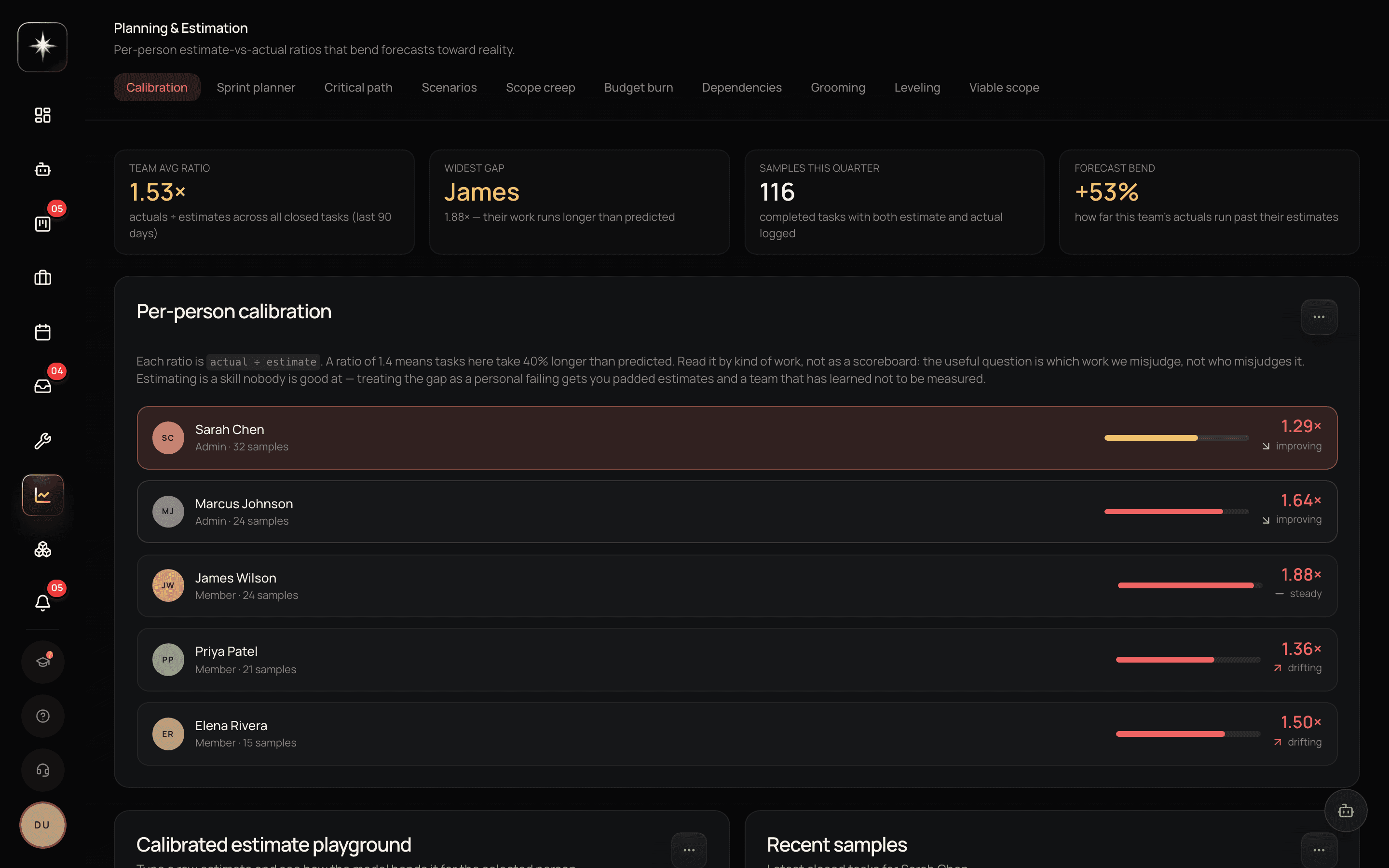
And the total uses the calibrated forecast rather than the raw sum of estimates. That is why the planner's number is often larger than the arithmetic you did yourself, and the difference is the part your team historically underestimates by.
When those two corrections make the sprint not fit, that is the planner working. The alternative is finding out three weeks later.
Commitments, and why they get recorded
What you commit to at the start of a sprint gets recorded. That matters because the interesting question at the end is not 'did we finish' but 'did we finish what we said we would'.
Those are different questions with different answers. A team that finishes a sprint's worth of work, none of which was in the plan, has a prioritization problem that a completion rate hides completely.
The recorded commitment is also what makes the next plan better. Over a few periods you learn your actual delivery rate against commitment, which is a far more useful planning input than velocity in the abstract.
The timeline
The timeline view sequences work across projects and milestones, and it is where dependencies stop being abstract.
A chain of three dependent tasks is invisible on a board — three cards, three owners, looks fine. On the timeline it is a bar that ends where it ends, and a two-day slip on the first one moves the last one by two days.
Use it for the specific question boards cannot answer: if this slips, what else does? That is the question worth asking before you agree to a date, and the only surface that answers it.
Horizons: different precision for different distances
The mistake that ruins quarterly planning is treating it as a long sprint — assigning specific tasks to specific weeks three months out, and then spending the quarter maintaining a plan that was wrong by week two.
The honest shape is different precision at different distances.
This sprint: specific tasks, specific owners, a capacity check. This is a commitment.
This quarter: themes and bets, with rough sizing. What you are committing to is direction and approximate scale, not a task list. Kavanah's quarter rollup and workspace bets are built for this shape.
Beyond that: intent. Written down so it can be argued with, not scheduled.
Planning each horizon at its own precision is what makes the quarterly plan survive contact, because it was never claiming to know which Tuesday something happens.
Plan honestly
- 1
Collect availability before you plan
Portfolio → Resources. Capacity from headcount is arithmetic on a fiction; capacity from responses is a number.
- 2
Run a sprint plan and accept the calibrated total
If the planner says it does not fit, it does not fit. That number is your history, not pessimism.
- 3
Check the timeline for dependency chains
Before agreeing to any date, look at what else moves if the first thing slips.
- 4
Plan the quarter as bets, not tasks
Themes with rough sizing. A quarterly plan made of specific weekly tasks is wrong by week two and maintained for twelve.
What to watch
- Commitment delivery rate
- Share of what you committed to at sprint start that actually completed in the sprint.
- Healthy signal: Stable and known. This is a far better planning input than raw velocity, because it accounts for what got displaced.
- Unplanned work share
- Share of completed work that was not in the plan at the start.
- Healthy signal: Whatever is true for your team, explicitly budgeted. A team that plans to 100% capacity and then absorbs 30% unplanned work is a team that misses every sprint.
- Capacity source
- Whether the capacity number came from collected availability or from headcount.
- Healthy signal: Collected. Headcount capacity is the single most common cause of a plan that was never possible.
Key takeaways
- ·Capacity comes from collected availability, not headcount — collect it before planning.
- ·The planner uses the calibrated forecast, which is why its total exceeds your arithmetic.
- ·Recorded commitments let you ask 'did we do what we said', which completion rate hides.
- ·The timeline answers the question boards cannot: if this slips, what else moves?
- ·Plan each horizon at its own precision — a quarter is bets and themes, not a task list.
Next: the level above the sprint — the portfolio, where projects roll into programs, objectives and budgets.